
Introduction
Las Vegas welcomed 38.5 million visitors in 2025, with nearly 6 million convention attendees navigating massive resort properties across the Strip. For properties managing multiple towers, convention wings, pool areas, and dining venues across hundreds of thousands of square feet, wayfinding signage isn't a one-time purchase—it's an ongoing operational cost.
The challenge is that most Strip properties face several compounding pressures that drive costs well beyond the initial budget line item:
- Constant renovation and rebranding cycles requiring signage overhauls
- Multilingual guest populations demanding translated or iconographic content
- Convention calendar shifts that trigger rapid, large-scale updates
- 24/7 operations that turn every unplanned replacement into a rush order
Wayfinding signage becomes expensive through poor planning, vendor fragmentation, and reactive replacements—not because it has to be. The sections below break down each cost driver and outline practical strategies to reduce spend without sacrificing navigation quality or brand consistency.
Key Takeaways
- Costs build quietly through reactive reprints, climate-driven material failures, ADA retrofits, and last-minute event updates
- Top cost drivers: property scale, materials not rated for desert heat, ADA gaps, and split procurement across multiple vendors
- Upfront decisions deliver the biggest savings: full-property scoping, climate-matched materials, and ADA compliance from the design stage
- Planned replacement schedules, inventory tracking, and format standardization cut rush-order premiums significantly
- Working with a single Las Vegas printer for design and production eliminates coordination delays and same-day turnaround becomes possible
How Wayfinding Signage Costs Build Up in Las Vegas Hotels
Costs rarely appear as a single budget item. Instead, they accumulate through layered events: a renovation on one wing triggers replacement of directional signs; a new restaurant outlet requires updated lobby directories; a convention booking demands temporary wayfinding ordered at rush rates because the event planner didn't finalize the floor plan until three days before setup.
Cost build-up in Las Vegas hotels is episodic but frequent, driven by the Strip's rapid renovation culture and relentless convention calendar. Hotel brands typically issue Property Improvement Plans (PIPs) every 6-7 years, with soft renovations every 3-5 years and hard renovations every 7-10 years.
That pace means resort properties often require signage updates multiple times per year — not once per cycle.
The problem is that several of these costs go unnoticed until they stack up:
- A sign ordered on the wrong substrate fails early in outdoor desert heat, triggering a replacement
- An ADA-non-compliant directional sign goes unnoticed until an inspection reveals violations
- A corridor update creates a consistency mismatch that requires reprinting an entire floor to maintain brand standards
Research indicates that organizations addressing ADA compliance reactively spend 35-40% more than those who plan proactively—a pattern that extends across all wayfinding cost categories.
Key Cost Drivers for Hotel Wayfinding Signage in Las Vegas
Property Scale
Large Las Vegas resorts can have hundreds of individual sign placements across lobbies, towers, pool areas, convention space, parking structures, and food & beverage venues. With over 150,000 hotel rooms and 14.5 million square feet of convention space citywide, even small per-unit inefficiencies multiply significantly. A $5 markup on a rush order becomes $2,500 when applied to 500 directional signs.
Material Specification
Las Vegas outdoor environments degrade signage faster than temperate markets. The city averages 320 days of sunshine annually, with summer temperatures reaching 104°F and UV index levels hitting 10-11+ (extreme category). Signs not rated for these conditions require earlier replacement.
Material durability comparison:
| Material Type | Outdoor Lifespan | Las Vegas Suitability |
|---|---|---|
| Calendered vinyl | 1-5 years | Poor (shrinkage, fading) |
| Cast vinyl | 7+ years | Excellent (UV stable) |
| Standard acrylic | 3-5 years | Moderate (requires UV laminate) |
| UV-rated acrylic | 7-10 years | Excellent |
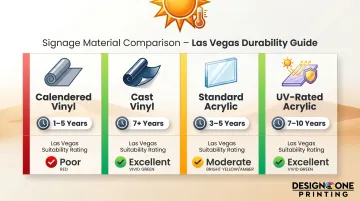
Cast vinyl offers superior color stability and dimensional stability compared to calendered options, though initial cost runs 20-30% higher. In Las Vegas heat, that upfront investment prevents premature replacement that would cost far more than the material differential.
ADA Compliance Requirements
Material choices affect lifespan — but non-compliant signs carry a different kind of cost entirely. Nevada hotels must follow ADA Section 703 guidelines for signage identifying permanent rooms and spaces. Requirements include:
- Tactile characters: Raised minimum 1/32 inch, uppercase, sans serif, 5/8 to 2 inches high
- Braille: Contracted (Grade 2), positioned below text with 3/8 inch minimum separation
- Mounting height: Baseline of tactile characters at 48-60 inches above floor
- Location: At doors, installed on latch side with 18x18 inch clear floor space
Signs failing inspection must be fully replaced, not patched. Civil penalties for ADA violations can reach $115,231 for first violations and $230,464 for subsequent violations— figures that make compliant production from the start the obvious financial choice.
Vendor Fragmentation
When design, printing, and installation are sourced separately, coordination delays extend timelines and markup layers inflate per-unit cost. Rush print orders cost 25-200% more than standard pricing depending on turnaround requirements. The industry "60-70% rule" adds another layer: base quoted prices often represent only 60-70% of final invoices once fees and shipping are factored in.
Cost-Reduction Strategies for Hotel Wayfinding Signage
Cost reduction depends on where in the lifecycle waste originates. Different strategies apply depending on whether costs stem from procurement decisions, management practices, or operational context.
Strategies That Reduce Costs by Changing Decisions
These approaches reduce cost by altering decisions made before or during procurement, when leverage to control spend is highest.
Conduct a full-property signage audit before ordering
Piecemeal ordering—adding signs floor by floor or zone by zone—means repeated setup fees, inconsistent finishes, and missed quantity pricing. A single comprehensive order for a defined scope typically costs less per unit than multiple small reactive orders.
Specify climate-appropriate materials from the start
For Las Vegas outdoor placements, pool areas, and unconditioned corridors, select UV-resistant substrates and finishes rated for high-heat conditions. The upfront cost difference between standard and desert-rated materials is typically smaller than a full replacement cycle.
Upgrading from calendered to cast vinyl adds approximately $0.50–$1.00 per square foot but extends service life from 3 years to 7+ years—a 133% durability improvement for a 15–20% price increase.
Build ADA compliance into the design brief
For permanent hotel spaces—guest room identification, restroom signs, elevator lobbies—ADA-compliant mounting, tactile characters, and contrast ratios are non-negotiable. Retrofitting non-compliant signs after installation costs substantially more than producing compliant signs initially.
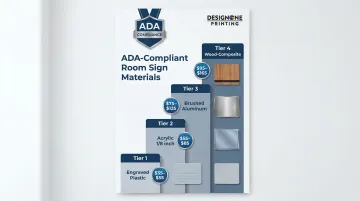
ADA-compliant room sign costs by material:
- 1/32-inch engraved plastic: $35–$55 per sign
- 1/8-inch acrylic: $55–$85 per sign
- Brushed aluminum: $75–$125 per sign
- Premium wood-composite: $95–$165 per sign
Consolidate design and printing with a single local vendor
Vendor consolidation eliminates inter-vendor coordination delays, removes markup layers, and ensures brand consistency without extra quality reviews.
For Las Vegas hotels, working with a local provider like Design One Printing—which handles graphic design, printing, and event branding under one roof—removes the overhead of managing multiple relationships while keeping turnaround fast when updates are needed.
Strategies That Reduce Costs by Changing How Signage Is Managed
Once signs are installed, waste compounds quietly through reactive decisions and inconsistent processes. These approaches address that post-installation phase directly.
Maintain a signage inventory log
Record each sign type, location, installation date, material, and expected service life. Without this, replacement decisions are made reactively when signs visibly fail, often at premium rush-order rates. A simple inventory review at each planned renovation cycle converts reactive spending into scheduled, budget-controlled procurement.
Standardize sign formats across property zones
When every floor or wing uses a bespoke design, each replacement becomes a new design project. Standardizing dimensions, fonts, and template layouts means future reorders require only content changes, not full creative development. This reduces design fees to near zero for repeat orders.
Stage replacements by priority zone
Guest-facing primary wayfinding—lobby directories, elevator corridor signs, entrance directionals—should be on a proactive replacement schedule. Back-of-house and secondary signage can be replaced on a condition-triggered basis. This approach keeps quality high in revenue-impacting areas while avoiding the budget spike of a simultaneous full-property refresh.
Brief front-of-house staff on damage reporting
Early detection of signage degradation allows for low-cost replacement of individual pieces before damage creates a brand or navigation problem requiring wider-scope intervention.
Strategies That Reduce Costs by Changing the Context Around Signage
The operational environment itself—layout change frequency, placement logic, and supply chain decisions—determines how much signage actually costs to maintain over time. These approaches target that context.
Audit guest navigation behavior before finalizing sign placement
Placing directional signs at every conceivable junction without evaluating where guests actually lose their way results in unnecessary sign quantity. A targeted placement strategy—focused on decision points where guests must choose a route—typically requires fewer signs to achieve the same navigational outcome.
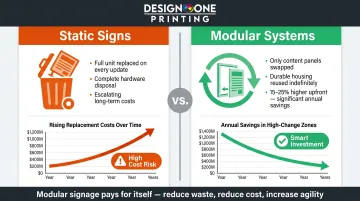
Use modular or insert-based systems in high-change zones
Convention wings, rotating restaurant tenants, and seasonal outdoor spaces require frequent updates. Fully printed signs in these areas require complete replacement when any detail changes. Modular systems allow content panels to be reprinted and swapped without replacing the sign housing, reducing materials cost and eliminating disposal of functional hardware. The housing cost is recovered quickly: upfront investment runs 15–25% higher than static signs, but facilities with frequent layout changes can save thousands annually in replacement costs.
Source wayfinding signage locally in Las Vegas
For Strip properties that operate continuously, navigation gaps aren't an option. Having a print partner within driving distance removes shipping surcharges and extended lead times that inflate emergency replacement budgets.
Local sourcing also enables same-day or next-day turnaround when urgent replacements are needed—eliminating the 25–200% rush order premiums charged by out-of-state vendors managing overnight freight.
Conclusion
The cost of hotel wayfinding signage in Las Vegas is not fixed—it's shaped by decisions made at every stage, from how a scope is defined to how replacements are managed years after installation. Reducing cost requires identifying where in that lifecycle waste originates, not simply choosing the cheapest sign at purchase.
The most cost-effective wayfinding programs in Las Vegas hotels run on the same four elements: comprehensive upfront planning, material and compliance decisions locked in at the design stage, standardized formats for easy reordering, and a local print partner who can turn around replacements fast when property needs shift.
If your hotel is starting a wayfinding project or replacing aging signage, Design One Printing works with Las Vegas hospitality properties on exactly this kind of production — from floor graphics and meter boards to directional panels, with same-day and rush turnaround available. Reach the team at (702) 530-6277 or orders@designoneprinting.com.
Frequently Asked Questions
How much does wayfinding signage typically cost for a Las Vegas hotel?
Costs vary widely based on property size, sign quantity, material specification, and whether design is included. Small-scale projects range from $5,000–$25,000, while comprehensive wayfinding systems for large Strip properties can exceed $150,000–$500,000. For accurate budgeting, request an itemized quote based on a full sign schedule rather than per-unit pricing alone.
What types of wayfinding signs do Las Vegas hotels typically need?
Core categories include lobby directories, corridor directionals, elevator landing signs, ADA room number signs, amenity identification, outdoor entrance signage, and event wayfinding. Large Strip properties typically need all of these across multiple towers, plus specialized signs for pool areas, parking structures, and convention wings.
Are all hotel wayfinding signs required to be ADA compliant in Nevada?
ADA compliance applies to signs identifying permanent rooms or spaces (guest rooms, restrooms, conference rooms) and requires tactile characters, braille, specific mounting heights, and color contrast. Directional signs must meet visual contrast standards but don't require tactile elements. Non-compliance can result in retrofits and fines up to $115,231 per violation.
How often should hotel wayfinding signage be replaced or updated?
Interior signs with UV-rated materials typically last 7–10 years; exterior signs in Las Vegas's heat may need replacement every 3–5 years. Scheduling an inventory review at each planned property renovation is more cost-effective than waiting for signs to visibly fail.
What is the most cost-effective material for hotel directional signs in Las Vegas?
Match the substrate to placement: acrylic or aluminum composite works well indoors, while exterior and pool-adjacent signs need UV-rated, moisture-resistant materials like UV-laminated acrylic or cast vinyl. In Las Vegas's extreme climate, spending 15–20% more upfront on UV-rated materials typically extends lifespan by 100–200%.
Can wayfinding signage be updated quickly if a Las Vegas hotel changes its layout or adds a new venue?
Yes—with the right setup. Standardized formats and modular systems in high-change zones minimize redesign time. Working with a local provider like Design One Printing means most formats are ready within 24–48 hours, versus 5–10 business days from out-of-state vendors.