
Introduction
Request quotes from three magazine printers without knowing what drives pricing, and you'll get three very different numbers — with no clear explanation for the gap. Most publishers discover this the hard way, assuming costs are roughly comparable until the quotes come back.
Magazine printing costs vary widely, from well under $1 per copy for large runs to $8 or more for small specialty editions. This 25x range is driven by quantity, paper stock, binding method, page count, and finishing choices — each decision compounds the next. A 500-copy run on gloss cover stock with saddle-stitch binding costs fundamentally differently than 5,000 copies on uncoated text with perfect binding.
This guide covers typical pricing ranges across print volumes, the key cost drivers that push your invoice up or down, the full cost picture beyond the per-copy price, and practical ways to estimate and reduce your budget without sacrificing quality.
Key Takeaways
- Per-copy magazine printing costs range from $0.30 for large runs (10,000+ copies) to $8.00+ for small specialty runs (under 100 copies), depending on specs and volume.
- Print quantity is the dominant cost lever—moving from 100 to 10,000 copies reduces per-unit cost by approximately 90% because fixed setup costs spread across more units.
- Paper weight, page count, binding method, and finishing options drive the next biggest cost swings; choosing 100 lb silk over 70 lb uncoated can triple per-copy costs.
- Design ($500–$5,000/issue), pre-press, proofing, and distribution (USPS Marketing Mail starts at $0.227/piece) can easily double your total project cost.
- Spend more when print quality reflects your brand; match lower-cost specs to pilot issues or high-volume handouts.
How Much Does It Cost to Print a Magazine?
There is no single fixed price for magazine printing. The per-copy cost depends on a combination of quantity, specifications, and print method. The ranges below cover the three main volume tiers so you can match your print run to the right method and budget from the start.
Two common mistakes: underbudgeting a short run by assuming bulk pricing applies, or over-speccing a pilot issue with premium finishes before the concept is validated. Knowing the numbers upfront avoids both.
Typical Cost Ranges by Print Volume
Approximate per-copy costs vary across three volume tiers:
| Volume Tier | Per-Copy Range | Print Method | Key Dynamic |
|---|---|---|---|
| Short run (under 250 copies) | $3.98 - $8.00+ | Digital | No plate setup; higher per-unit click charges |
| Mid-run (250-1,000 copies) | $1.00 - $6.00 | Digital or short-run offset | Crossover zone; quote both methods |
| Large run (1,000+ copies) | $0.30 - $2.00 | Offset (sheetfed or web) | Setup costs amortized across volume |
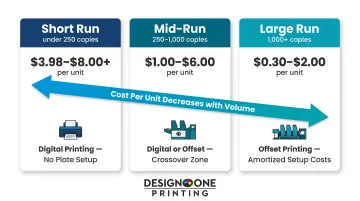
These per-copy ranges generally include paper, printing, and binding. They exclude design, shipping, proofing, and special finishes.
Short-Run Printing (Under 250 Copies)
Short-run printing typically covers quantities of 25 to 500 copies using digital presses. At this tier, 100 copies of a standard 40-page magazine cost approximately $3.98 per copy ($398 total) for full-color, 8.5" x 11", perfect-bound with standard coated stock.
Digital printing eliminates plate setup costs entirely, making it the default method for small volumes. However, per-unit costs are highest here because fixed costs (equipment, labor, facility overhead) spread across fewer copies.
Who it's best for:
- Pilot issues testing new publications
- Event programs and conference materials
- Portfolio pieces and client presentations
- Niche publications with limited audiences
- Internal corporate magazines
Mid-Run Printing (250-1,000 Copies)
This tier represents the transition zone where digital and offset methods compete. At 500 copies of a 40-page magazine, per-unit cost drops to $1.12—a 72% reduction from 100-copy pricing. At 1,000 copies, it falls further to $0.71/unit.
Both digital and short-run offset work well here. The crossover point typically occurs between 500 and 1,000 copies. Offset requires $500+ in plate setup but delivers lower per-copy costs at scale, while digital offers zero setup and faster turnaround.
Who it suits:
- Local businesses producing seasonal catalogs
- Association newsletters and member publications
- Regional trade show exhibitors
- Brand magazines with targeted distribution
- Quarterly corporate communications
Large-Run Printing (1,000+ Copies)
At scale, setup costs become a negligible fraction of the per-copy price. At 10,000 copies of a 40-page magazine, per-unit cost drops to $0.41, while a 64-page magazine at 102,000 copies costs just $0.33/unit.
Heatset web offset or sheetfed offset is standard at these volumes. Total project cost rises with quantity, but per-unit cost drops sharply — setup expenses like plates, press calibration, and make-ready don't scale with the print run.
Who benefits most:
- Regular publishers with subscription bases
- Large trade show exhibitors distributing to thousands
- Corporate magazine programs for customers/employees
- Retailers producing seasonal lookbooks
- Publishers with established distribution channels
Key Factors That Affect Magazine Printing Costs
Final magazine printing cost is shaped by a combination of physical specifications, production choices, and timing. Each decision compounds on the others — change one variable and it shifts the cost of everything downstream.
Quantity and Print Method
Print volume drives per-unit cost more than any other factor, and it determines which printing method makes economic sense:
Digital printing suits small runs with:
- Zero plate setup costs
- Faster turnaround (same-day to 3 days)
- Higher per-unit click charges
- Flexibility for mid-run revisions
- Economical below 500 copies
Offset printing (heatset web or sheetfed) suits large runs with:
- $500+ plate setup costs
- Lower per-unit costs at scale
- Superior color fidelity on coated stocks
- Economical above 1,000-2,000 copies
- Best for consistent reprints
The crossover point falls between 500 and 2,000 copies depending on complexity. Request parallel quotes in this range.
Paper Type, Weight, and Finish
Paper selection creates a compounding cost effect. Roughly 50% of printing costs come from paper and 50% from manufacturing, so upgrading stock hits your budget from both directions simultaneously.
Weight considerations:
- Lighter text stock (60-70 lb) reduces material and shipping costs
- Heavier premium stock (100 lb) looks more substantial but increases both categories
- Cover stock vs. self-cover: separate cover stock adds a second press run and paper expense
Finish options:
- Gloss: Vibrant, shiny appearance; shows fingerprints
- Matte: Clean, non-reflective; better for text-heavy content
- Satin: Middle ground between gloss and matte
- Uncoated: Natural feel; absorbs ink differently
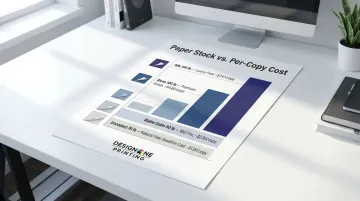
Upgrading from 70 lb uncoated to 100 lb silk can more than triple per-copy costs (from $2.32 to $7.47 for comparable runs).
Page Count and Trim Size
More pages require more paper and production time, directly increasing cost. Doubling page count from 40 to 80 pages increases cost by approximately 69%, not 100%, because fixed costs (setup, binding) remain constant while variable paper/ink costs scale linearly.
Standard trim sizes like 8.5" x 11" and 5.5" x 8.5" are significantly more cost-efficient because they:
- Align with standard press sheet sizes
- Minimize paper waste during trimming
- Require no custom tooling or setup
Non-standard dimensions generate paper waste and may require custom dies, increasing both material and setup costs.
Binding Method
Binding method affects both cost and page count viability:
Saddle stitch (stapled spine):
- Suitable for 8-92 pages
- Lower cost (baseline)
- Works best for thinner magazines
- No spine for branding
Perfect binding (glued flat spine):
- Minimum 28-36 pages; ideal for 64+ pages
- About 2.4x more expensive than saddle stitch
- More polished, book-like appearance
- Allows spine printing for branding
- Required for higher page counts
Both methods have page count requirements: saddle stitch needs multiples of four; perfect binding needs multiples of two.
Finishing Options and Turnaround Time
Specialty finishes add incremental costs and are best reserved for covers or brand-critical elements:
Finish type estimates:
- Spot UV: $0.05-$0.20 per unit
- Foil stamping: $0.05-$0.20 per unit (plus $100-$500 die setup)
- Embossing/debossing: $0.10-$0.50 per unit (plus $80-$300 stamp setup)
- Die-cut windows: $0.10-$0.30 per unit (plus $100-$400 die)
Combined, specialty finishes can increase total cost by 10-20%.
Turnaround time: Rush production typically carries a 25-50% premium fee to offset expedited scheduling and labor. Standard turnaround (5-10 business days) avoids these fees.
The Full Cost Breakdown: Beyond the Per-Copy Price
The per-copy print price is only one component of what a magazine actually costs to produce and distribute. Several additional costs are consistently underestimated.
Design and Pre-Press
Design (layout, typography, image editing) and pre-press work (file setup, color correction, proofing) are separate from printing costs and can add 30–50% or more to your total project budget.
Magazine design ranges from $500 to $5,000 per issue depending on complexity. Layout rates run $5-$12.50/page, while pre-press file preparation typically costs $10-$50/page for basic technical work.
For first-time publishers, design costs often equal or exceed short-run print costs. A 40-page magazine at 200 copies might cost $1,500 to print but $2,000-$3,000 to design.
One way to reduce this overhead: work with a printer that offers in-house design services. Consolidating design and print under one roof eliminates vendor handoffs and file compatibility problems — Design One Printing in Las Vegas handles both, which can meaningfully cut total project cost.
Proofing
There are two proofing approaches with different cost implications:
Digital proofs:
- Typically provided free as standard pre-press
- Fast turnaround
- Good for basic layout and pagination checks
- Color accuracy is approximate
Hard-copy proofs:
- Physical sample printed on actual paper stock
- Adds cost (varies by printer)
- Critical for color-sensitive or premium projects
- Recommended for first-time offset projects
Skipping proofing to save money risks costly reprints if errors aren't caught before the full run.
Shipping and Distribution
Heavier paper stocks and larger page counts increase freight weight and shipping costs. Bulk delivery to a single location is far cheaper than split shipments to multiple venues.
For subscription magazines, USPS Marketing Mail starts at $0.227/piece (commercial pricing, minimum 200 pieces). Every Door Direct Mail Retail is $0.247 for flats up to 3.3 oz. Heavier stock increases per-piece postage when magazines exceed weight thresholds.
To keep postage manageable, consider lighter uncoated stocks for mail-distributed runs and reserve premium coated paper for hand-distributed or event copies.
Example Cost Scenarios
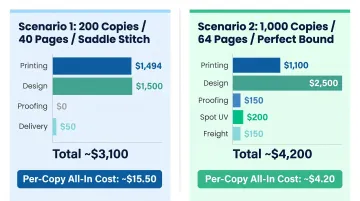
These two scenarios show how per-copy print costs, design, proofing, and delivery stack up into a real total-project number.
Scenario 1: 200 copies, 40 pages, 8.5" x 11", saddle-stitched
Based on published pricing data, a 200-copy run on premium 100 lb silk paper costs approximately $7.47/copy ($1,494 total). On lighter 70 lb uncoated stock, per-copy cost would fall to the $3.00-$4.00 range depending on the printer.
Adding design ($1,500), digital proofing (included), and local delivery ($50) brings total project cost to approximately $3,000-$3,100.
Scenario 2: 1,000 copies, 64 pages, 8.5" x 11", perfect-bound, 80 lb gloss text / 100 lb gloss cover
Published benchmarks show 1,000 copies of a 60-page magazine at $1.00/unit and 80 pages at $1.20/unit. A 64-page specification falls between these—approximately $1.00-$1.20/unit, or $1,000-$1,200 total for printing alone.
Adding design ($2,500), hard-copy proofing ($150), spot UV on cover ($200), and bulk freight shipping ($150) brings total project cost to approximately $4,000-$4,200, or $4.00-$4.20 per copy all-in.
How to Cut Magazine Printing Costs Without Cutting Corners
The cheapest option isn't always the best value. Cutting the wrong costs—paper quality, binding integrity, or proofing—can undermine the magazine's perceived quality and reader experience. The strategies below target waste and inefficiency, not quality.
Most impactful cost-reduction strategies:
- Print larger quantities: moving from 500 to 1,000 copies can cut per-unit cost by 30-40%
- Choose standard trim sizes (8.5" x 11" or 5.5" x 8.5") to minimize paper waste
- Select mid-weight coated paper stocks (70-80 lb) instead of premium 100 lb silk
- Use saddle stitch over perfect binding when page count allows (under 64 pages)
- Request digital proofs instead of hard-copy proofs when color precision isn't critical
- Extend turnaround time to avoid 25-50% rush fees
- Limit specialty finishes to the cover only, not interior pages
Most common cost mistakes:
- Focusing only on per-copy price without factoring in design, shipping, and proofing—total cost is what matters
- Over-speccing a pilot run with premium finishes before validating the concept
- Choosing the cheapest printer without evaluating quality, turnaround reliability, or support
- Ordering 250 copies when 500 would only cost 20% more on a per-unit basis
- Skipping proofing to save $100-$150, then discovering a pagination error after printing 1,000 copies
How to Estimate the Right Budget for Your Magazine Print Run
Accurate budgeting starts with defining the purpose of the magazine. A one-off event program for a trade show has very different requirements than a quarterly brand publication or subscription magazine. Aligning specs to purpose prevents over- and under-investment.
Key questions to answer before requesting a quote:
- How many copies do you need? Factor in distribution method, audience size, and extras for staff or archives
- What trim size and page count? Standard sizes cost less; page count must be in multiples of 4 (saddle stitch) or 2 (perfect bound)
- What paper stock and finish? Gloss suits image-heavy layouts; matte works better for text-heavy content; uncoated is ideal for note-taking
- What binding method? Saddle stitch works for under 64 pages; perfect binding suits thicker publications
- What is your distribution model? Bulk shipping to one location, direct mail, and event hand-distribution each carry different costs
- What is your timeline? Rush fees typically add 25–50%, so planning ahead preserves budget
Working with a full-service printer that covers design, file prep, and printing under one roof simplifies the budgeting process. Design One Printing in Las Vegas offers same-day quotes and can accommodate tight event timelines, which reduces the risk of hidden costs that come from coordinating multiple vendors.
Frequently Asked Questions
How much does it cost to print a magazine?
Per-copy costs typically range from under $1 for large print runs (5,000–10,000+ copies) to $7 or more for small specialty runs (under 250 copies). The final number depends on quantity, page count, paper stock, binding method, and finishing options—quantity has the single largest impact on per-unit economics.
How much does it cost to print 100 copies of a magazine?
For a standard 8.5" x 11", 40-page, saddle-stitched magazine on coated stock, expect roughly $3.98/copy ($398 total). Premium paper choices can push this to $5–$8/copy. At 100 copies, digital printing is the norm—and per-copy costs are at their highest.
How can I print a magazine cheaply?
Print larger quantities to spread fixed costs (moving from 250 to 500 copies cuts per-unit cost significantly), use standard sizes like 8.5" x 11" and saddle stitch binding, choose mid-weight paper (70–80 lb text) instead of premium stock, skip rush fees by planning ahead, and limit specialty finishes to the cover only.
What is the cost of printing 300 pages?
A 300-page perfect-bound magazine runs roughly $10–$18/copy at 100 copies, dropping to $3–$6/copy at 1,000 copies and lower at higher volumes. For an accurate quote, provide your quantity, trim size, paper stock, and binding method.
Why are print magazines so expensive?
Printing costs include fixed setup (plates, make-ready, equipment), materials (paper alone is roughly 50% of total cost), and labor for binding and finishing. At low volumes, those fixed costs hit harder—setup that adds $3/copy at 100 copies shrinks to $0.03/copy at 10,000.
Does turnaround time affect magazine printing costs?
Yes. Rush or expedited turnaround typically carries a 25–50% premium fee to cover expedited scheduling and overtime labor. Planning ahead and choosing standard turnaround times (5–10 business days for most projects) is one of the simplest ways to keep printing costs lower without compromising quality.