This guide walks through how to run direct mail campaigns that are affordable, targeted, and measurable. From using USPS Every Door Direct Mail (EDDM) to designing pieces that drive calls, you'll have everything you need to start — or sharpen — your local mail strategy.
Key Takeaways
- Direct mail averages a 4.4% response rate — roughly 36x higher than email
- EDDM lets you reach entire neighborhoods for around $0.247 per piece postage, no mailing list needed
- Postcards (especially oversized 6x9) offer the best cost-to-response balance for most local services
- A clear offer, single call-to-action, and QR code matter more than how much you spend on print
- Track ROI using unique QR codes, promo codes, or dedicated phone numbers for each campaign
Why Direct Mail Still Works for Local Service Businesses
There's a reason homeowners stick postcards to the fridge instead of bookmarking digital ads. Physical mail is tangible — it gets picked up, skimmed, and often kept. According to the 2025 ANA/DMA Response Rate Report, direct mail achieves a 4.4% average response rate compared to just 0.12% for email — approximately 36 times more responses per piece sent.
That gap is widening, not narrowing. Nielsen research cited by AdQuick found 67% of consumers admit to banner blindness, with 41% actively tuning out social media ads. Direct mail read rates, by contrast, run between 80–90%.
Why Local Services Are a Natural Fit
Geographic targeting is where direct mail outperforms every digital channel. Your service area is already defined — a few ZIP codes, a cluster of neighborhoods. Your customers are homeowners making local decisions about HVAC repairs, lawn care, and cleaning services. They trust businesses they've seen nearby more than ones that appear in a feed.
Direct mail fills the awareness gap efficiently:
- Repeat service businesses (plumbing, cleaning, HVAC) benefit from staying top-of-mind between jobs
- Geographic credibility builds faster when neighbors see the same brand in their mailbox
- High-ticket services (roofing, remodeling) benefit from the trust that physical mail carries
Direct Mail + Digital: Better Together
A postcard with a QR code functions as a complete multi-channel campaign. The physical piece creates awareness; the QR code sends recipients to a booking page, tracks the response, and feeds data back into your digital targeting.
Royal Mail research cited by Postalytics shows that combining print and digital media produces campaigns 400% more effective than digital-only efforts.
How to Keep Direct Mail Costs Low
EDDM: The Budget-Friendly Foundation
Every Door Direct Mail (EDDM) is the most practical entry point for local service businesses. You select postal carrier routes using the USPS EDDM online tool, and your piece is delivered to every address on those routes — no mailing list, no permit required for the Retail option.
Current USPS postage rates:
| EDDM Type | Postage Per Piece | Permit Required? |
|---|---|---|
| EDDM Retail | $0.247 | No |
| EDDM BMEU | $0.242 | Yes |
| First-Class stamp | $0.73 | No |
EDDM postage runs roughly 66% less than a standard stamp. Volume requirements: minimum 200 pieces, maximum 5,000 pieces per ZIP code per day (Retail).
What a Campaign Actually Costs
Real cost = printing + postage. A realistic example for a 500-piece postcard mailing:
- Printing (oversized postcard, mid-range): ~$0.20–$0.35 per piece
- EDDM postage: $0.247 per piece
- Approximate total: $225–$300 for 500 pieces
All-inclusive EDDM pricing through full-service providers starts around $0.39 per piece. Compare that to purchased mailing lists, which typically add $100–$300 per 1,000 names on top of printing and postage.
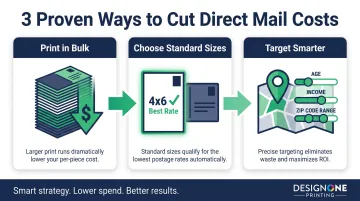
Three Ways to Reduce Per-Piece Cost
- Print in bulk — per-unit costs drop significantly as volume increases. Print a larger batch and mail in phases over a season
- Choose standard postcard sizes — 4x6 postcards are cheapest; oversized EDDM flats cost a bit more but generate measurably better response
- Target smarter, not broader — use the EDDM tool's demographic filters (household income, age range, household size) to select the routes most likely to contain your ideal customers. Fewer, better-targeted pieces often beat high-volume blanketing on ROI
Working with a printer that handles EDDM fulfillment end-to-end — route selection, piece bundling, labeling, and USPS drop-off — eliminates the submission errors that most commonly delay campaigns. For Las Vegas businesses, Design One Printing offers full EDDM fulfillment so you hand off files and they handle the rest.
Best Direct Mail Formats for Local Service Businesses
Postcards
Postcards are the default choice for most local service campaigns — no envelope to open, immediate visibility, and the lowest combined print and postage cost.
Best use cases:
- Seasonal promotions (pre-winter HVAC tune-ups, spring lawn care)
- New customer offers and neighborhood introductions
- Service reminders for past clients
- Grand opening announcements
Oversized postcards (6x9 or larger) achieve 4.0%–5.5% response rates versus lower rates for standard formats, per ANA data. The incremental printing cost is typically justified by the response lift.
Flyers and Door Hangers
Flyers work when you need more space — a service menu, pricing tiers, or multiple offers side by side. They're well-suited for restaurants, cleaning services, and contractors.
Door hangers work especially well for tight-radius campaigns around a job site. After completing a job, canvassing the surrounding block puts your offer in front of neighbors who can already see the finished work — which is why conversion rates tend to run higher than most other local formats.
Brochures and Tri-Folds
For services with a longer decision cycle — roofing, solar installation, full bathroom remodels — a tri-fold brochure gives prospects something to keep and review. The higher printing cost makes sense when a single job can run $5,000–$20,000 and the prospect needs time to decide before calling.
Seasonal Campaign Ideas That Convert
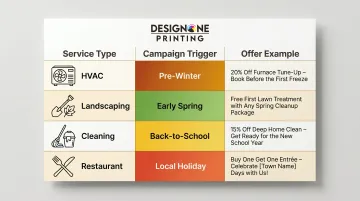
Each format above pairs naturally with a seasonal trigger. The table below shows how that looks in practice:
| Service Type | Campaign Trigger | Offer Example |
|---|---|---|
| HVAC | Pre-winter | "Schedule your tune-up before December — 15% off" |
| Landscaping | Early spring | "Free first mow for new neighbors" |
| Cleaning | Back-to-school | "Deep clean special — mention this card" |
| Restaurants | Local event or holiday | "Bring this postcard, get a free appetizer" |
For Las Vegas businesses that need both design and printing handled without coordinating multiple vendors, Design One Printing produces postcards, flyers, brochures, and door hangers in-house — with same-day and rush turnaround options that make last-minute seasonal campaigns workable.
How to Target the Right Neighborhoods
Using the USPS EDDM Mapping Tool
The USPS EDDM online tool lets you search by ZIP code or city, then browse individual carrier routes. Each route typically covers 400–800 addresses.
Key filters available:
- Route type — residential vs. business/mixed
- Median household income
- Age ranges (default filter: 25–44)
- Average household size
Select routes that match your customer profile. An HVAC company targeting homeowners with older systems might filter for higher-income residential routes in established neighborhoods. A budget cleaning service might prioritize high-density residential routes.
Radius Targeting: Work the Neighborhood
One of the most effective targeting strategies: focus on neighborhoods surrounding a recent job site. When you've just finished a roof, HVAC installation, or landscaping project, the surrounding blocks represent warm prospects. They've seen your truck, possibly your yard sign. A postcard arriving that same week closes the loop.
This "job site radius" approach also lets you start small. Pick 2–3 routes around your work area and expand as the campaign gains traction.
When to Use a Purchased Mailing List Instead
EDDM works for broad neighborhood saturation. A purchased list makes sense when you need precision:
- Targeting only homeowners (renters don't hire roofers)
- Filtering by home value for premium services
- Reaching households with specific purchase history (pool owners, recent home buyers)
Purchased lists cost $100–$300 per 1,000 names and require a USPS permit. For most local service businesses, EDDM is the right first move — then layer in purchased lists once you have a working campaign to build on.
Designing Direct Mail That Gets Results
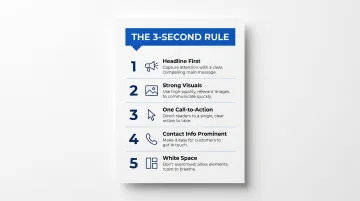
The Five Elements That Drive Response
A recipient decides whether to keep or discard your mailer in about 3 seconds. Design for that window:
- Headline first — lead with a benefit, not your company name ("Cut your energy bill this winter" beats "ABC HVAC Services")
- Strong visuals: show the outcome, not just the service — a clean kitchen, a lush lawn, a comfortable family
- One call-to-action — call, scan, or visit. Pick one, because multiple CTAs dilute response
- Contact info prominent — phone number and website visible without hunting
- White space: a crowded postcard gets discarded. Breathing room keeps eyes on your message
Offers and Urgency
A mail piece without an offer is just brand awareness — and urgency is what converts it into a call:
- "10% off your first service — expires [date]"
- "Free estimate for neighbors of our recent jobs on [Street Name]"
- "Mention this postcard for a free add-on service"
Testing different offers typically produces a 20%–50% response lift, so treat your first campaign as a baseline to beat, not a final answer.
Getting the design right is half the battle. For Las Vegas businesses, Design One Printing handles layout and printing under one roof — so you're not losing days coordinating between a separate designer and print shop before your campaign even launches.
Measuring ROI and Optimizing Your Campaign
Tracking Mechanisms That Work
Knowing which pieces drove responses lets you cut waste and double down on what works. The most practical tracking options for local direct mail:
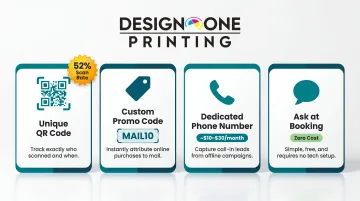
- Unique QR codes linked to a campaign-specific landing page — 52% of consumers have scanned a QR code on direct mail in the past year
- Custom promo codes — "Use code MAIL10 for your discount"
- Dedicated phone number per mailing batch (call tracking services cost ~$10–$30/month)
- Simply asking — "How did you hear about us?" at booking captures a meaningful percentage
Calculating ROI: A Simple Formula
ROI = (Revenue from tracked responses − Total campaign cost) ÷ Total campaign cost × 100
Example: 500 postcards at ~$275 total cost. If 3% respond (15 calls) and 5 become customers at $200 average job value:
- Revenue: $1,000
- Cost: $275
- ROI: ~264%
For higher-ticket services like HVAC installation or roofing, even a 1–2% response rate on a modest mailing generates strong returns. PostcardMania case studies show HVAC businesses generating between $11,000 and $285,000 in revenue from postcard campaigns, with documented ROIs ranging from 356% to over 2,000%.
Improving Campaign by Campaign
Once you have ROI data in hand, use it to drive the next mailing — not just to report results:
- A/B test one variable per mailing — headline, offer amount, or design layout
- Track which postal routes performed — cut low-response routes, expand high-response ones
- Run campaigns in a 90-day cadence — systematic testing at this pace can produce 25–40% cumulative response-rate improvement within six months
Most local businesses see their sharpest gains between campaigns two and four, once they've identified which routes and offers actually convert.
Frequently Asked Questions
How much does direct mail marketing cost?
EDDM postage runs roughly $0.247 per piece, plus $0.10–$0.35 for printing — putting all-in costs at $0.39–$0.60 per piece depending on size and volume. A 500-piece postcard mailing typically runs $200–$300 total.
Does direct mail marketing still work?
Yes — and the data is clear. Direct mail achieves a 4.4% average response rate versus 0.12% for email, per the 2025 ANA/DMA report. For local service businesses targeting homeowners in a defined area, physical mail remains one of the highest-ROI channels available.
What are the trends for direct mail in 2026?
The dominant trend is integration: QR codes and personalized URLs that connect physical mail to digital tracking, combined with digital retargeting for people who received a mailer. With Google and Facebook CPCs up 20–30% over the past two years, more local businesses are reallocating budget to direct mail for lower cost-per-acquisition.
What is the best type of direct mail for local service businesses?
Oversized postcards (6x9 or EDDM-compliant sizes) deliver the best balance of cost, visibility, and response rate — typically 4.0%–5.5% response. Flyers work better when you need to convey more detail; brochures fit services with longer sales cycles like roofing or remodeling.
How do I target specific neighborhoods without a mailing list?
Use USPS Every Door Direct Mail (EDDM). You select carrier routes using the free online mapping tool, and your piece is delivered to every address on those routes — no individual addresses or permit required. Routes can be filtered by income, age, and household size.
How can I measure whether my direct mail campaign worked?
Use a unique QR code linked to a campaign landing page, a custom promo code, or a dedicated phone number to connect responses to the specific mailing. Calculate ROI by comparing total campaign cost (print + postage + design) against revenue generated from tracked responses.