This guide covers everything you need to plan a compliant EDDM campaign before printing a single piece: official USPS size minimums and maximums, the most popular postcard dimensions, paper specifications, and realistic cost estimates for campaigns at 5,000 pieces.
Key Takeaways
- EDDM pieces must exceed at least one flat threshold: height >6.125", length >10.5", or thickness >0.25"
- Maximum dimensions are 15" long × 12" tall × 0.75" thick; Retail weight cap is 3.3 oz.
- Current EDDM Retail postage is $0.247 per piece — flat rate regardless of size
- Popular sizes: 6.25×9, 6.25×11, 8.5×11, and 9×12 — all qualify with comfortable margin
- 14pt C2S coated stock is the standard choice; 80lb gloss cover often fails the stiffness requirement
What Is EDDM Printing?
Every Door Direct Mail (EDDM) is a USPS program that lets businesses mail to every address on selected carrier routes — no mailing list required. Pieces are addressed generically to "Postal Customer" rather than named individuals, and route selection happens through the USPS EDDM Online Tool using ZIP Code and basic demographic filters.
USPS classifies EDDM pieces as Marketing Mail flats, not letters. That classification drives every size and format rule in this guide. A piece that falls below flat minimums gets reclassified as a letter and is ineligible for EDDM rates.
EDDM works well for any local business trying to saturate a specific geographic area at lower postage than standard First-Class mail. Common users include:
- Restaurants and food delivery services
- Real estate agents promoting new listings
- Home service companies (HVAC, plumbing, landscaping)
- Dental and medical offices
- Gyms, salons, and retail shops
In Las Vegas, it's a go-to tactic for businesses targeting residential neighborhoods near new service corridors or convention-adjacent zip codes.
USPS EDDM Size Requirements Explained
EDDM pieces must meet both a minimum and a maximum dimension set — fall short or go over, and the piece gets rejected at the counter.
Minimum Size: The OR Logic
A piece qualifies as a flat if it exceeds at least one of these thresholds:
| Dimension | Flat Minimum (at least one) | Absolute Floor |
|---|---|---|
| Height | >6.125" (6-1/8") | 3.5" |
| Length | >10.5" | 5" |
| Thickness | >0.25" | 0.007" |
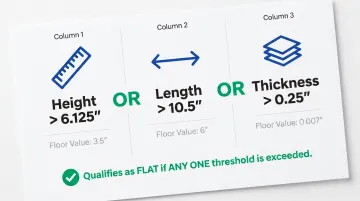
Most EDDM postcards qualify by exceeding the height minimum. A 6.25×9 piece clears 6.125" with a comfortable 0.125" margin — enough to absorb bleed and trim variance without risk.
Any piece that falls below all three thresholds qualifies as a letter — not a flat — and cannot be mailed under EDDM.
Maximum Size Requirements
- Maximum length: 15"
- Maximum height: 12"
- Maximum thickness: 0.75"
- Maximum weight (Retail): 3.3 oz
- Maximum weight (BMEU): less than 16 oz
The 3.3 oz Retail weight cap is easy to overlook — a 9×12 postcard on 14pt stock can get surprisingly close to that ceiling. Weigh a sample before ordering a full run.
Shape and Physical Standards
- Rectangular only — no die-cut or irregular shapes
- Corners: square or rounded, with radius not exceeding 1/8"
- Uniform thickness throughout
- Flexible — must bend without damage during processing
- Folded pieces (menus, brochures) are permitted if the folded dimensions fall within the min/max range and the piece is secured to prevent opening in transit
Once your piece clears these physical requirements, the next step is choosing the right size for your campaign goals and budget.
Most Popular EDDM Sizes and Which to Choose
EDDM Retail postage is $0.247 per piece regardless of format — and that changes everything about size selection. A 6.25×9 and a 9×12 cost identical postage. The only difference is print cost — which makes going larger more compelling than it first appears.
6.25" × 9" — The Standard Choice
The most widely ordered EDDM size. It clears the 6.125" height minimum by just enough, fits every standard mailbox without bending, and keeps print costs at the low end of the range.
Best for: single-offer promotions, restaurant specials, salon deals, home service companies with one primary message.
6.25" × 11" — Extended Format
The extra length creates natural space for condensed menus, service lists, or coupon strips without jumping to a larger paper category. Print cost is marginally higher than the 6.25×9, but still accessible for most budgets.
Best for: restaurants with limited menus, businesses with 3–4 offers, service companies listing multiple service areas.
8.5" × 11" — Letter-Size Impact
This format is hard to miss in a mailbox stack — it matches a standard sheet of paper in every dimension. The added surface area works well for detailed menus, real estate listings, and multi-service layouts where you need room to breathe.
9" × 12" — Maximum Visibility
The largest commonly used EDDM format. It dominates the mailbox, making it the go-to for grand openings, political campaigns, and high-impact neighborhood saturation. Two practical cautions:
- It's the most expensive per piece to print
- At 14pt stock, it approaches the 3.3 oz. Retail weight limit — weigh a physical sample before your full run
Each size has a clear use case. Here's how they stack up at a glance:
Quick size comparison:
| Size | Best Use Case | Mailbox Fit |
|---|---|---|
| 6.25×9 | Single offer, broad reach | Fits all mailboxes |
| 6.25×11 | Menus, service lists | Fits all mailboxes |
| 8.5×11 | Detailed layouts, listings | Fits T2+ mailboxes |
| 9×12 | Grand openings, high impact | May require carrier handling |
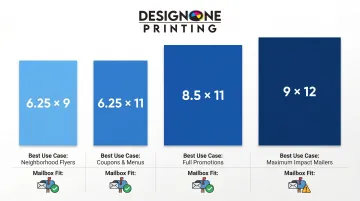
Design One Printing handles EDDM printing for all four formats — including same-day and rush turnaround for businesses in Las Vegas working against tight campaign deadlines.
EDDM Paper and Print Specifications
Paper Stock: What the Numbers Actually Mean
USPS requires a minimum thickness of 0.007" (7pt). An 80lb gloss cover stock clocks in at roughly 7.4pt — technically compliant, but with no meaningful margin for manufacturing variance. One sheet at 0.0069" can get an entire bundle rejected at the counter.
14pt C2S coated stock is the industry standard for EDDM postcards — it provides double the required minimum, resists bending in the mail stream, and feels substantial in hand. That tactile quality matters more than most people assume; a flimsy mailer signals budget constraints before anyone reads the offer.
Stock options at a glance:
| Stock | Thickness | EDDM Eligible | Notes |
|---|---|---|---|
| 80lb Gloss Cover | ~7.4pt | Barely | Almost no safety margin |
| 10pt C2S Coated | 10pt | Yes | Acceptable baseline |
| 12pt C2S Coated | 12pt | Yes | Good feel, mid-range cost |
| 14pt C2S Coated | 14pt | Yes | Industry standard |
| 16pt Premium Matte | 16pt | Yes | Premium feel, higher cost |
Print File Specifications
Once you've selected your stock, file setup is the next place rejections happen. Build every EDDM file to these specs before sending to press:
- Bleed: 0.125" on all sides (set this after confirming your trim size)
- Safe zone: 0.25" from the trim edge — keep all critical text and images inside this margin
- Resolution: 300 DPI minimum (350 DPI preferred)
- Color mode: CMYK
- Indicia placement: Upper right corner of the address side, within 1.625" from the right edge and 1.375" from the top edge
- Recipient line: "Local Postal Customer," "Postal Customer," or "Residential Customer" — never an individual name
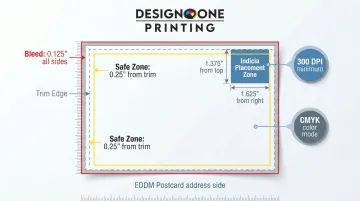
Before any file goes to production, Design One Printing runs a preflight check covering bleed setup, trim dimensions, resolution, and USPS clear zone compliance — catching spec issues before they become print problems.
EDDM Printing and Postage Costs
Every EDDM campaign has two cost components: postage (fixed) and printing (variable). At current USPS rates, EDDM Retail postage is $0.247 per piece effective April 26, 2026 — the same rate whether you're mailing a 6.25×9 or a 9×12.
Printing Cost Ranges at 5,000 Pieces
| Size | Print Cost (per piece) | All-In with Postage |
|---|---|---|
| 6.25×9 | $0.18–$0.30 | $0.43–$0.55 |
| 6.25×11 | $0.20–$0.32 | $0.45–$0.57 |
| 8.5×11 | $0.22–$0.34 | $0.47–$0.59 |
| 9×12 | $0.25–$0.38 | $0.50–$0.63 |
Ranges vary by paper stock, coating, and printer. Prices drop significantly at 10,000+ pieces.
How to Calculate Your Total Campaign Cost
The formula is straightforward:
(Print cost per piece + $0.247 postage) × total quantity = total campaign cost
Worked example:
- 5,000 pieces at 6.25×9 on 14pt stock: ($0.22 + $0.247) × 5,000 = ~$2,335
- 5,000 pieces at 8.5×11 on 14pt stock: ($0.28 + $0.247) × 5,000 = ~$2,635
The difference between those two formats is roughly $300 total — about $0.06 per piece — for significantly more design real estate. For service businesses promoting a seasonal offer or coupon, that extra space typically earns back the cost.
EDDM Retail vs. EDDM BMEU
| Feature | EDDM Retail | EDDM BMEU (DDU) |
|---|---|---|
| Postage rate | $0.247/piece | $0.242/piece |
| Permit required | No | Yes |
| Daily volume cap | 5,000 pieces/ZIP | None |
| Weight limit | 3.3 oz. | <16 oz. |
| Drop-off | Local post office | Business Mail Entry Unit |
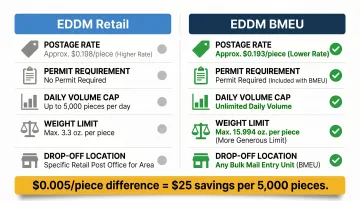
The $0.005/piece difference saves $25 on a 5,000-piece mailing. BMEU makes sense only at scale — tens of thousands of pieces, recurring campaigns, or pieces that exceed 3.3 oz.
For most local businesses, EDDM Retail is the simpler path — and Design One Printing handles the full fulfillment process: route selection, bundling in sets of 100, facing slips, and post office drop-off. That means no permit applications, no manual bundling, and no trips to a Business Mail Entry Unit.
Common EDDM Size Mistakes to Avoid
Mistake 1: Designing at 6″ × 9″ Instead of 6.25″ × 9″
A 6″ tall piece fails EDDM's 6.125″ height minimum and gets reclassified as a letter — the most common reason EDDM submissions get rejected. Commercial printers offer 6.25×9 (or 6.5×9) specifically to clear this threshold. Always use those dimensions; never round down.
Mistake 2: Confusing Bleed Size with Trim Size
USPS measures the finished, trimmed piece — not the file including bleed. A document set at exactly 6.125″ with 0.125″ bleed on each side will trim to 5.875″ and fail. Set your trim size first (e.g., 6.5×9), then add 0.125″ bleed on top to create a 6.75×9.25 file. The trim is what USPS sees.
Mistake 3: Wrong Indicia or Missing Address Panel
Every EDDM Retail piece requires a specific indicia — a standard stamp, metered impression, or bulk mail imprint won't pass. The indicia and address panel must meet these requirements:
- Indicia text: Must read "EDDM RETAIL," "PRSRT STD," and "ECRWSS" in all caps at minimum 4-point type
- Placement: Upper right corner of the mailpiece
- Recipient line: Must read "Local Postal Customer," "Postal Customer," or "Residential Customer"
USPS provides a downloadable EDDM Retail indicia on their EDDM page.
Frequently Asked Questions
What is EDDM printing?
EDDM (Every Door Direct Mail) is a USPS program that lets businesses mail to every address on a carrier route without a mailing list. Pieces are addressed to "Postal Customer" and sent at a flat discounted postage rate, making it an affordable way to blanket a neighborhood or zip code.
What are the EDDM sizes?
EDDM pieces must exceed 6.125" in height OR 10.5" in length, with a maximum of 12" × 15". Popular compliant sizes are 6.25×9, 6.25×11, 8.5×11, and 9×12. Standard postcards (4×6 or 5×7) don't qualify — they fall below the flat minimums.
How much does EDDM printing cost?
At 5,000 pieces, printing typically runs $0.18–$0.38 per piece depending on size and stock. Add $0.247 per piece for EDDM Retail postage. Total all-in cost for a 5,000-piece 6.25×9 campaign runs approximately $2,100–$2,700.
Can I mail a standard postcard through EDDM?
No. The smallest practical EDDM-compliant size is 6.25×9, which clears the 6.125" height threshold with margin to spare.
What paper stock is best for EDDM mailers?
Use 12pt or 14pt C2S coated board stock. It feels substantial in hand, survives the mail stream without bending, and projects professionalism. Avoid 80lb gloss cover — at ~7.4pt, it barely meets the 0.007" USPS minimum and feels thin.
What is the difference between EDDM Retail and EDDM BMEU?
EDDM Retail is self-service — drop bundled pieces at your local post office with no permit required at $0.247/piece. EDDM BMEU requires a bulk mailing permit and Business Mail Entry Unit drop, saving $0.005/piece at $0.242. That gap rarely justifies the added complexity unless you're mailing at very high volumes.