Introduction
Your email lands in an inbox alongside 150 others. Your social ad gets scrolled past in under a second. Meanwhile, a well-designed postcard sits on someone's kitchen counter for days.
That's the reality of direct mail in 2025. While most local businesses pour budget into digital channels, physical mail delivers response rates that dwarf email — according to the ANA/DMA Response Rate Report, direct mail achieves a 5.3% response rate for house lists compared to just 0.6% for email.
For local businesses in Las Vegas, Henderson, or any tight geographic market, that gap matters — your mail reaches a defined neighborhood your competitors are largely ignoring.
This guide covers what direct mail marketing is, why it still works for local businesses, how to build and execute a campaign from scratch, and how to measure results accurately.
Key Takeaways
- Direct mail marketing sends physical promotional materials — postcards, brochures, flyers — directly to a targeted audience's mailbox
- Response rates significantly outperform email and social media, especially for locally focused businesses
- EDDM (Every Door Direct Mail) is the most budget-accessible option for neighborhood-level saturation with no mailing list required
- A successful campaign needs one clear goal, precise targeting, a compelling offer, strong design, and a tracking mechanism
- An in-house printer handling both design and production keeps your brand consistent and your timeline on track
Why Direct Mail Marketing Still Works for Local Businesses
The Case for Physical Mail in a Digital World
The average American is exposed to approximately 10,000 ads per day, up from roughly 1,600 in the 1970s. Every inbox, every feed, every webpage is fighting for attention simultaneously. Physical mail simply isn't competing in that same crowded space.
The numbers back this up. Direct mail response rates average 5.3% for existing customers and 2.9% for cold prospects — versus 0.6% for email, 0.5% for paid search, and 0.4% for social media ads. That gap reflects a structural advantage, not a fluke.
Trust plays a role too. A MarketingSherpa survey of 1,200 U.S. consumers found that 76% trust direct mail when making a purchase decision — ranking it above TV and well above online ads. A physical piece in someone's hand carries credibility that a banner ad simply can't replicate.
Unlike an email that disappears in seconds, a postcard stays visible. It sits on the counter, goes in a drawer, gets picked up again. That dwell time translates directly into more chances to act — and for local businesses, that's where the real advantage begins.
Why Local Businesses Benefit Most
National brands blast campaigns across millions of addresses. Local businesses don't need that — and the targeting flexibility of direct mail actually favors smaller, geographically focused operations.
A Las Vegas HVAC company, neighborhood restaurant, or Henderson real estate agent can select specific ZIP codes, carrier routes, or income brackets. Every piece reaches someone who could realistically become a customer, not someone 300 miles away.
The offline-to-online behavior it drives is measurable too:
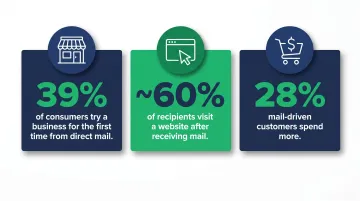
- 39% of consumers try a business for the first time because of a direct mail piece (PostcardMania, 2024)
- ~60% of direct mail recipients report that mail encouraged them to visit a website
- Mail-driven customers spend 28% more than those who didn't receive physical mail (USPS data)
For local businesses, that combination of geographic precision and purchase-driving behavior makes direct mail one of the most practical marketing investments available.
Types of Direct Mail Formats for Local Businesses
Common Formats and When to Use Each
Not every format fits every campaign. Choosing the wrong one wastes budget; choosing the right one multiplies your results.
Postcards
- Best for: Grand openings, seasonal promotions, event announcements, limited-time offers
- Why they work: No envelope to open — the message is seen immediately
- Keep the offer simple, the headline bold, and the design uncluttered
- Design One Printing offers postcards in multiple sizes (4×6, 4.25×6, 6.5×9) with glossy or matte finishes
Brochures, Flyers, and Self-Mailers
- Best for: Restaurants with menus, service companies with package tiers, businesses with complex offerings
- More panels mean more room, but also more risk of clutter — design discipline matters here
- Single-vendor production (design + print in one place) prevents file errors, color drift, and version mismatches between rounds
- Available fold configurations include tri-fold, z-fold, and half-fold in 5.5×8.5 or 8.5×11 formats
Newsletters and Letter Mailers
- Best for: Re-engagement campaigns, loyalty programs, relationship-building with established customers
- These are relationship tools, not broadcast tools — suited for deepening connections rather than pushing a one-time offer
- Works well for businesses with an existing list who want to deepen connections rather than just push an offer
Response rates vary by format. Letters in envelopes lead at 8.38%, followed by self-mailers at 6.27%, flyers/brochures at 4.61%, and postcards at 2.79%. Higher response formats also cost more to produce, so match the format to the value of a converted customer.
How to Build a Direct Mail Campaign: Step by Step
Step 1 — Set a Clear Goal and Define Your Audience
Every campaign must begin with a single, specific objective. "Get more customers" isn't a campaign goal. "Generate 30 calls for HVAC tune-up appointments in October" is.
The goal determines everything downstream: the format, the offer, the mailing list, and how you measure success. Vague goals produce vague results.
Three targeting approaches for local businesses:
| Targeting Method | Best For | Cost Level |
|---|---|---|
| Your own customer list | Retention, re-engagement, loyalty | Low (you own the data) |
| Purchased demographic list | New customer acquisition by ZIP, income, age | Moderate |
| EDDM (carrier route saturation) | Neighborhood-wide brand awareness, grand openings | Lowest |
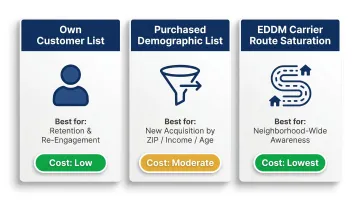
EDDM requires no purchased list — pieces are addressed to "Postal Customer" and delivered to every address on selected routes. It's the fastest and cheapest entry point for local businesses with no existing list. Design One Printing manages the full EDDM process — route selection, USPS compliance, bundling, and local post office drop-off — so you can focus on your offer, not the logistics.
Purchased lists add cost but allow filtering by income, household size, business type, or past behavior — useful when you need precision over volume.
Step 2 — Craft an Offer and Message That Compels Action
The single most common direct mail mistake is generic messaging. "We're the best in town!" gets thrown in recycling. A specific, tangible offer gets kept, acted on, or passed to someone who needs it.
Your offer must answer one question immediately: What's in it for me?
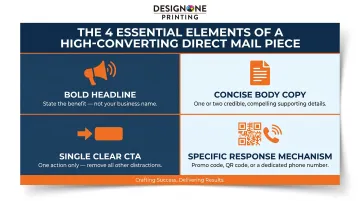
Every direct mail piece needs these four elements:
- Bold headline — state the benefit, not the business name
- Concise body copy — support the headline with one or two credible details
- Single clear CTA — one action, not three options
- Specific response mechanism — promo code, QR code linking to a landing page, or dedicated phone number
Multiple CTAs dilute effectiveness. "Call us, visit our website, or stop by the store" forces a decision the recipient will defer. Pick one and make it effortless to follow.
Step 3 — Plan Your Send Schedule and Follow-Up
Once your message is locked, timing is the next lever. Mail 2–3 weeks before your desired action date to account for production time and postal delivery windows. Seasonal promotions, new location openings, and slow-period traffic drives all benefit from intentional scheduling.
One tactic that consistently outperforms single-channel sends: send the physical piece first, then follow up with a matching email one week later. Same offer, same visual identity, same CTA. The physical piece primes recognition; the email catches people in a buying moment. Neither channel alone achieves what both together do.
Direct Mail Design: Creating Pieces That Demand Attention
Design Principles That Drive Response
A recipient decides whether to engage or discard a piece in about three seconds. Your design doesn't need to be complicated — it needs to be immediate.
The core principles:
- One dominant image
- A single bold headline that states the benefit
- Minimal body text (fewer words, not more)
- Ample white space to let the message breathe
Cluttered layouts push people toward the recycling bin. Every element competing for attention means nothing wins.
Print quality communicates before anyone reads a word. Paper stock weight, finish choice, and color accuracy all say something about the business behind the piece. A thin, washed-out postcard undermines even a strong offer — heavier card stock and clean full-color printing (glossy for visual products, matte for a premium feel) signal a business worth trusting.
Personalization compounds all of this. According to InfoTrends research, personalized direct mail can increase response rates by up to 36% compared to generic mailers. Addressing recipients by name, referencing their neighborhood, or customizing offers by segment (new movers vs. returning customers) doesn't require a massive budget — it requires variable data printing, which Design One Printing handles as part of their full direct mail production process.
Making Your Call to Action Work Hard
Good design gets your piece noticed. Your call to action is what turns that attention into a response — and it needs to work just as hard.
Every direct mail piece needs exactly one primary CTA, and it must include a deadline.
"Call us anytime" gets deferred indefinitely. "Call by March 31st to lock in your spring discount" creates urgency that forces a decision now. Open-ended offers get mentally set aside and rarely revisited.
Your urgency trigger options:
- Offer expires [specific date]
- Limited to the first [number] respondents
- RSVP by [date] to reserve your spot
- Code valid through [date] only
The specificity matters. "Limited time offer" gives people permission to think about it later — a hard date with a real consequence (price goes up, spots fill, discount disappears) forces the decision now.
Every Door Direct Mail (EDDM): A Local Business Superpower
Every Door Direct Mail (EDDM): The Low-Cost Route to Local Reach
EDDM is a USPS program that lets businesses mail to every address on selected carrier routes — no purchased mailing list required. At $0.247 per piece (EDDM Retail), it's the most cost-accessible direct mail option available to local businesses. Since 2011, more than 33 billion EDDM pieces have been sent by businesses of all sizes.
How to Select Routes That Actually Convert
The USPS EDDM online mapping tool at eddm.usps.com lets you search by address or ZIP code, then filter carrier routes using U.S. Census data:
- Age range (19 to 85+)
- Average household income
- Average household size
You can see the residential address count and estimated cost per route before committing. For a Las Vegas gym, routes near UNLV or dense residential neighborhoods make sense. For a high-end home services company, filtering for higher-income households in areas like Summerlin produces a more qualified audience.
Choose routes based on your customer profile, not proximity alone. The cheapest routes rarely reach the right people.
Common EDDM Mistakes That Kill Results
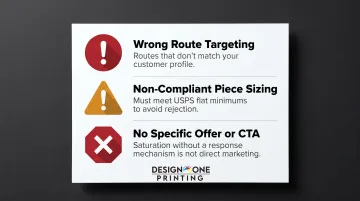
Three mistakes account for most wasted EDDM budgets:
- Mailing to routes that don't match your target customer — reach only matters when the audience fits
- Ignoring USPS size requirements — EDDM pieces must qualify as flats, meaning they exceed at least one minimum dimension (length over 10.5", height over 6.125", or thickness over 0.25") while staying within maximum limits. Non-compliant pieces get rejected at the post office
- Sending without a specific offer or CTA — neighborhood saturation with a generic awareness message is brand advertising, not direct response marketing
Design One Printing handles the full EDDM compliance process: piece sizing, USPS paperwork, bundling in sets of 100, facing slips, and local post office drop-off. No navigating postal regulations on your own.
How to Measure the Success of Your Direct Mail Campaign
Tracking Methods That Create Real Attribution
Three methods create a direct, measurable link between a mailed piece and a response:
- Unique promo codes — only appear in the mailer, so any redemption is attributable to the campaign
- Dedicated landing page URL or QR code — routes to a campaign-specific page; traffic and conversions are trackable in analytics
- Call-tracking numbers — a phone number used only in the mailer captures inbound calls by source
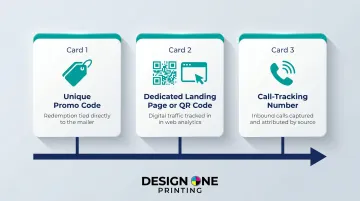
Use at least one. Ideally two, so you capture both digital and phone responses.
Calculating ROI and Setting Realistic Benchmarks
The standard ROI formula:
ROI = ((Revenue Generated − Total Campaign Cost) ÷ Total Campaign Cost) × 100
Example: A campaign costs $2,000 and drives $4,600 in revenue. ROI = (($4,600 − $2,000) ÷ $2,000) × 100 = 130%.
The industry median ROI for direct mail is 29%, though well-executed campaigns frequently exceed this. Better targeting, a stronger offer, and clean design consistently push results well past that benchmark.
Test Before You Scale
Once you know your ROI target, validate it before committing full budget. Send 500–1,000 pieces to a subset of your list — enough to test the offer, design, and targeting without major risk.
What to evaluate in the test:
- Response rate vs. your baseline goal
- Which response mechanism drove the most conversions (QR code, promo code, phone)
- Whether the offer generated the right type of inquiry
If the test performs, scale up. If it doesn't, adjust the offer or targeting before spending more.
Frequently Asked Questions
How much does it cost to do direct mail marketing?
All-in costs (design, print, postage) typically range from $0.35–$0.55 per piece for standard postcards to $0.75–$1.25 for letter mailers. EDDM is the most budget-friendly option at around $0.30–$1.00 per piece all-in, with postage as low as $0.247 per piece.
What is direct mail marketing?
Direct mail marketing is the practice of sending physical promotional materials — postcards, brochures, flyers, catalogs — to a targeted list of recipients' physical mailboxes. Unlike email or digital advertising, it's tangible, harder to ignore, and doesn't require the recipient to be online to see it.
Does direct mail marketing still work?
Yes. Direct mail response rates average 5.3% for house lists, compared to 0.6% for email — nearly nine times higher. Pairing it with a digital follow-up using the same offer compounds results beyond either channel alone.
What companies use direct mail advertising?
Businesses across nearly every industry use direct mail — local restaurants, HVAC and plumbing companies, real estate agents, retailers, healthcare providers, and national brands alike. Local businesses benefit most because geographic targeting lets them focus every dollar on neighborhoods where their actual customers live.
What is an example of direct mail marketing?
A local HVAC company mails an oversized postcard to every home in two Henderson ZIP codes — $49 seasonal tune-up offer, QR code to book online, deadline at month's end. At under $0.60 per piece to print and mail, the QR code tracks every booking directly back to the campaign.
What are common mistakes when using EDDM?
The three most common: selecting carrier routes that don't match the target customer demographic (saturation only works when the audience is relevant), ignoring USPS size and weight specifications that can cause pieces to be rejected at the post office, and mailing without a specific offer and deadline that motivates a response.