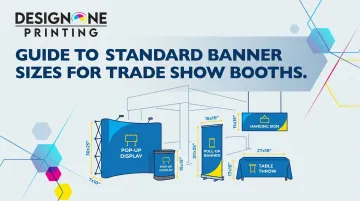
Banner sizing is one of the most consequential decisions an exhibitor makes — and one of the least researched before placing an order. Get it wrong and you've either wasted your visual real estate or violated the venue's height limits and face removal on setup day.
This guide covers every standard trade show banner size, maps each to common booth configurations, explains the four factors that determine the right choice, and includes the file specs your printer needs to produce clean results.
Key Takeaways
- Most common sizes: 33″×80″ retractable banners, 24″×60″ X-banners, vinyl flat banners from 2′×4′ to 4′×8′, and 8′×10′ backdrops
- Your booth footprint determines everything: a 10×10 inline and a 20×20 island have completely different size constraints
- Legibility rule: EXHIBITOR Magazine recommends 1 inch of letter height for every 3 feet of viewing distance in trade show environments
- Print files need 150 DPI at full size with 0.25″ bleed on all sides
- Layering a retractable stand, table front vinyl, and backdrop builds a complete booth presence without overcrowding
Standard Trade Show Banner Sizes: A Quick-Reference Guide
Trade show banners fall into four functional categories based on where and how they display within a booth.
Retractable (Roll-Up) Banners
The two dominant sizes are 33″×80″ (standard) and 47″×80″ (wide format). Both are freestanding, set up in under a minute, and stand nearly 7 feet tall — visible from across a crowded aisle.
- 33″ width fits comfortably inside a 10×10 booth without eating into walkway space
- 47″ width provides stronger visual impact in 10×20 or larger configurations
- Both stand approximately 6.7 feet tall including the base — well within inline booth height limits at Las Vegas venues
For Las Vegas exhibitors, Design One Printing produces retractable stands in 33.5″×80″ and 36″×80″ configurations, available in tiered quality options (Good, Better, Best) on materials including Super Flat Vinyl and Clear PET Banner. A 24″×80″ option is also available for tighter spaces or side-by-side display setups.
X-Banner Stands
The 24″×60″ X-banner is the budget-conscious, ultra-portable option — ideal for artist alleys, small vendor tables, or supplementary messaging within a larger booth. One design note: the X-frame grips the banner at all four corners, so keep critical content well inside those edges.
U.S. Press also publishes X-banner templates in 32″×72″ and 48″×78″ for exhibitors needing more surface area.
Vinyl Flat Banners
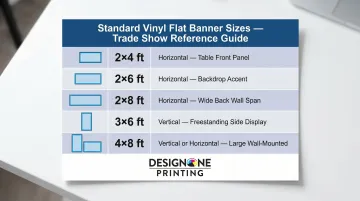
Standard vinyl flat banner sizes for trade show use:
| Size | Orientation | Typical Use |
|---|---|---|
| 2′×4′ | Horizontal | Table front panel |
| 2′×6′ | Horizontal | Backdrop accent, side panel |
| 2′×8′ | Horizontal | Wide back wall span |
| 3′×6′ | Vertical | Freestanding side display |
| 4′×8′ | Vertical or horizontal | Large wall-mounted format |
Backdrops and Back Wall Displays
Full back-wall backdrops typically run 8′×8′ or 8′×10′ for standard 10×10 booths, scaling to 10×10 for larger inline configurations. These fall into two categories:
- Vinyl backdrops are durable, cost-effective, and grommeted or hemmed for hanging
- Tension fabric displays use dye-sublimated graphics on wrinkle-resistant polyester stretched over aluminum frames, a better fit for photography-heavy booths and repeat events
Design One Printing produces both types, including NFPA 701 flame-retardant certified materials required by Las Vegas convention venues.
How to Match Banner Size to Your Booth Type
Booth footprint governs maximum banner dimensions before any other factor. Here's how each configuration maps to standard sizes.
10×10 Inline Booth
The most common configuration per IAEE 2023 Guidelines. The standard combination:
- One 33″×80″ retractable banner at the back wall
- One 2′×4′ table front vinyl covering the display table
This covers your vertical visibility and horizontal branding without consuming walkway space. At Las Vegas venues (LVCC, Venetian Expo, Caesars Forum), inline booth back walls max out at 10 feet — your 80″ retractable stand clears this comfortably.
Don't push wider than 47″ or taller than the venue limit. Overcrowding a 10×10 with oversized displays undermines the professionalism of the entire booth.
10×20 Inline Booth
Double the floor space opens several layout options:
- Two 33″ or 47″ retractable banners flanking a central 8′×10′ backdrop
- One 2′×8′ horizontal vinyl spanning the full back wall width
- A combination of both for layered depth
Whichever layout you choose, consistent banner heights across the back wall are critical. Mismatched heights immediately signal a disorganized exhibitor — order matching hardware from the same vendor to prevent this.
20×20 Island or Peninsula Booth
Open-sided configurations change everything. With aisle exposure on three or four sides, you need vertical signage on each exposed panel and potentially overhead hanging elements.
- 3′×6′ or 4′×8′ vertical banners for each exposed side panel
- Ceiling-hung hanging banners in 5′, 8′, 10′, or larger diameter formats for cross-hall visibility
Venue height constraints vary significantly across Las Vegas properties — confirm limits before you order.
| Venue | Max Fixture Height | Hanging Sign Range | Peninsula Cap | Island Cap |
|---|---|---|---|---|
| Venetian Expo (Hall G) | 12 feet | N/A | 16 feet | 20 feet |
| Caesars Forum | Venue limit | 18–24 feet | 16 feet | 20 feet |
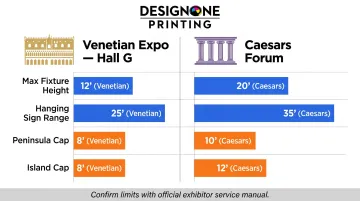
Download the official exhibitor service manual for your specific show before ordering any large-format signage. Venue rules vary by show, not just by building.
Key Factors That Determine the Right Banner Size
Standard dimensions give you a starting point. These four variables determine the right combination for your specific setup.
Viewing Distance and Font Legibility
EXHIBITOR Magazine applies a trade-show-specific standard: 1 inch of letter height for every 3 feet of viewing distance. At a typical aisle distance of 12 feet, your headline text needs to be at least 4 inches tall — roughly the height of a standard envelope. Larger text requires more vertical space, so banner size and font size are directly linked decisions. A banner cramped with small fonts serves no one walking past at a normal pace.
EXHIBITOR Magazine also recommends placing key messaging in the top two feet of your display — typically the only area visible above the crowd. Text below eye level (roughly 5 feet from the floor) is effectively invisible on a busy show floor.
Booth Height Restrictions and Venue Rules
Every trade show venue publishes an exhibitor service manual with specific height limits by booth type. Inline booths at Las Vegas venues max out at 10 feet for back wall structures; the front half of the booth drops to 4 feet. Island booths allow up to 20 feet.
Ordering a backdrop without checking these specs is a setup-day risk. Banners that exceed venue limits get asked to come down — and reprinting after arrival is an expensive, stressful problem to solve.
Message Volume and Design Density
EXHIBITOR Magazine's signage guidelines recommend keeping 40% of your banner surface as empty space. The accompanying word count guidance is stark: a maximum of 6 to 10 words on the entire graphic, with a 3-second read test as the benchmark.
More content demands more surface area to stay uncluttered. If your design includes a logo, tagline, product image, and QR code, a 33″ wide banner will feel cramped. Either simplify the message or move to a wider format.
Lead Time and Local Sourcing
Many exhibitors fly into Las Vegas and discover sizing issues only after arriving at the venue. Having access to a same-day print provider near the convention corridor eliminates that risk entirely.
Design One Printing, located minutes from the Las Vegas Strip, handles emergency reprints for exactly these situations. Key capabilities for last-minute needs include:
- Same-day vinyl banner production up to 10 feet wide
- 24–48 hour expedited turnaround on fabric backdrops (when hardware is available)
- Direct delivery to LVCC, the Venetian Expo, and Caesars Forum docks
The shop can also consult on sizing and booth layout before an order is placed — a much easier conversation than reprinting the morning of setup.
Banner File Setup: Resolution, Bleed, and Design Specs
Choosing the right physical size is half the equation. Incorrectly set up files produce blurry, pixelated banners regardless of how good the printer is.
Resolution:
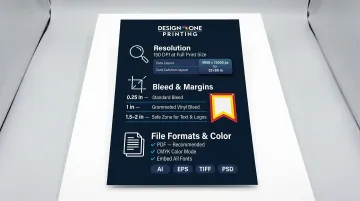
- Set artwork at 150 DPI at full print dimensions — this is the practical standard for trade show banners viewed from several feet away
- A 33″×80″ banner at 150 DPI = 4,950 × 12,000 pixels
- Vector logos and text scale without quality loss and should be used wherever possible; rasterizing logos at low resolution is one of the most common mistakes in large-format file prep
Bleed and safe margins:
- Extend artwork 0.25 inches beyond the trim edge on all sides — this prevents white borders after finishing
- For vinyl banners with grommets, increase bleed to 1 inch and keep critical text at least 1.5–2 inches from edges to clear hems and hardware
- Never place QR codes or logos in the corners of a retractable banner — the hardware attachment covers those areas
File formats:
- Accepted formats: PDF, AI, PSD, TIFF, EPS, JPG, and PNG — PDF is recommended for final submissions
- Submit files in CMYK color mode with fonts embedded
- Design One Printing's prepress team runs automated preflight checks on every file and flags issues before production starts — a critical safeguard when you're up against a convention deadline
Common Banner Sizing Mistakes That Hurt Your Booth
Most booth display problems trace back to a handful of avoidable decisions made before the show floor opens:
- Ordering by budget instead of booth dimensions. A banner too small to read from the aisle serves no purpose. Reprinting a correctly-sized banner always costs more than ordering right the first time.
- Using a single banner type for the entire booth. One retractable stand leaves a space looking underdeveloped. A layered setup — retractable at the back, table front vinyl, and a fabric backdrop — creates visual depth and naturally draws attendees in.
- Missing venue height limits until setup day. Arrive at the Venetian Expo with a 14-foot custom backdrop and discover Hall G caps all fixtures at 12 feet, and you've got a problem that the exhibitor service manual would have flagged weeks earlier. Download it before placing any order.
Frequently Asked Questions
What banner size is most effective?
Effectiveness depends on booth size and viewing distance, but the 33″×80″ retractable banner is the most versatile single choice for most trade show setups. It's visible from across an aisle while fitting comfortably in a 10×10 booth — making it a reliable starting point for first-time exhibitors.
What size banner for a 10×10 booth?
A 33″×80″ retractable banner at the back wall paired with a 2′×4′ table front vinyl is the standard combination. Avoid widths over 47″ or heights exceeding 10 feet unless the venue explicitly permits taller inline displays.
What is the standard booth size at a trade show?
The 10×10 foot inline booth is the industry standard — the IAEE baseline unit used across US conventions. Larger configurations (10×20, 20×20) and island setups scale up from there. Banner sizing should always scale with the booth's square footage.
Is 24″×36″ a good banner size?
For trade shows, no. A 24″×36″ banner is better suited for tabletop or counter displays. Floor-standing trade show banners in the 60–80″ height range offer far greater visibility from walking distance at typical aisle widths.
What resolution should banner artwork be?
Design artwork at 150 DPI at full print dimensions. Photos should be high-resolution originals — enlarging small web images to banner scale produces visible pixelation. Use vector files for logos and text whenever available.
How big is a 2×3 banner in feet?
A 2×3 banner measures 2 feet wide by 3 feet tall (24″×36″). This is a compact format suited for tabletop, podium, or close-proximity signage — not a primary floor-standing trade show display.