Princeton research found that people form impressions in as little as one-tenth of a second. That's how fast your welcome banner either anchors your brand or loses the moment.
Signage in these environments does three jobs at once: it communicates brand identity, guides foot traffic, and reduces the operational burden on your staff. Done poorly, it creates confusion and a forgettable first impression. Done well, it runs quietly in the background making everything feel effortless.
This guide covers the essential sign types for Las Vegas events, design principles that hold up at scale, material choices for Nevada's unique environment, and how to manage printing timelines — including what to do when you're 48 hours out and something has gone wrong.
Key Takeaways
- Las Vegas events demand signage that communicates instantly — attendees won't stop to read dense text
- Match each sign type to its job: welcome banners for identity, wayfinding for navigation, backdrops for social content
- Design for distance: 1 inch of letter height per 10 feet of viewing distance is the baseline rule
- Outdoor signage needs UV-resistant materials — standard indoor vinyl degrades fast in Nevada's desert heat
- Order standard signage at least 2 weeks out; specialty materials need 3–4 weeks (rush options available for true emergencies)
Essential Types of Event Venue Signage
Different sign types serve different strategic functions. Using the right combination is what separates a well-run event from one that feels improvised.
Welcome Banners and Entrance Signage
The welcome banner is your highest-impact first impression. Keep it simple: event name, logo, and date. The banner's job is immediate impact, not information delivery.
For large Las Vegas venues, size matters more than you might expect. A standard 24×36" banner reads fine in a smaller conference room but disappears in a convention hall. For events at the LVCC or Venetian Expo, consider panoramic entrance displays spanning 20–30 feet at 8–10 feet tall. Retractable banner stands in 33"–60" widths work well for flanking entrance points.
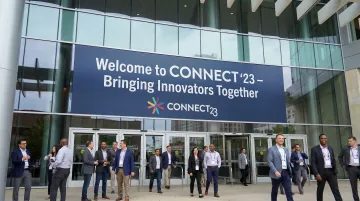
High-contrast design — white text on dark backgrounds, or bold color blocking — photographs well and reads instantly under convention hall lighting.
Directional and Wayfinding Signage
At venues like the LVCC, directional signage is infrastructure, not decoration. Research on wayfinding in large public buildings confirms that clear signage directly affects circulation efficiency and crowd safety. Place signs at every decision point: entrances, elevator lobbies, escalators, hallway intersections.
Practical placement guidance:
- Mount overhead directional signs high enough to remain visible above crowd height
- Place freestanding meter boards (24×36" up to 1m×2m) at registration exits and lobby crossroads
- Use floor graphics on sealed concrete or tile to direct traffic without requiring fixtures
- Add double-sided prints on freestanding signs for long corridors where approach angle varies
Color-coding zones — green for registration, blue for restrooms, red for emergency exits — reduces confusion, particularly at multi-session conventions where English may not be every attendee's first language.
Branded Backdrops and Step-and-Repeat Banners
A branded backdrop serves two functions at once: it creates a natural photo moment and generates organic social content every time a guest shares a photo.
Design best practices:
- Include the event logo, name, and a dedicated hashtag
- Use high-contrast colors that photograph well under mixed LED and spotlight conditions
- Position in high-traffic areas near registration or refreshment stations
- Opt for tension fabric (dye-sublimated stretch polyester) for a matte, wrinkle-free surface that photographs without glare
Standard sizes include 8×8, 10×10, and 10×20 configurations, with curved options that elevate VIP photo setups.
Informational Panels, Schedules, and Table Signs
Informational panels reduce repetitive staff questions by giving attendees a self-service reference point. Schedules, speaker lineups, sponsor recognition, and session room maps all work well as mounted rigid panels.
Effective placement: registration desks, room entrances, food courts, and networking hubs — anywhere attendees naturally pause. Avoid corners and afterthought placements.
For trade show floors, booth identification signs should be readable from 10–15 feet. Common formats include:
- Foam core boards (24×36" to 48×96") for lightweight single-day setups
- PVC panels for multi-day durability in high-traffic areas
- Meter boards (36×72" or 1m×2m) with easel or slot-base mounting
Safety and Compliance Signage
Safety signage is a legal requirement, not an optional add-on. OSHA 1910.37 requires exit signs with letters not less than 6 inches high with 3/4-inch principal strokes. ANSI Z535.2 governs the formatting of environmental and facility safety signs across five severity categories: DANGER, WARNING, CAUTION, NOTICE, and SAFETY INSTRUCTION.
Before setup, walk the venue to verify all permanent safety signage remains visible with your temporary structures in place. Identify locations where supplementary signage may be needed for high-density crowd areas or temporary builds.
Design Principles That Make Event Signage Stand Out
A well-designed signage system does two things at once: it guides attendees and reinforces your brand. Every sign should be instantly recognizable as part of your event — no second-guessing required.
Branding Consistency Across All Signage
Before ordering anything, establish a unified visual system:
- 2–3 brand colors — primary, secondary, and accent
- 2 fonts — one display font for headers, one clean sans-serif for body text
- Consistent logo rules — placement, clear space, and approved color versions
Apply these rules uniformly across welcome banners, directional signs, informational panels, and booth signage.
For sponsored events, consolidate sponsor logos onto a dedicated recognition banner rather than scattering them across every sign. This keeps the event brand front and center while giving sponsors a clean, dedicated space.
Typography, Color Contrast, and Readability at Scale
SEGD research reports that 65% of the world's population has imperfect vision — meaning two out of three attendees may be reading your signs through corrective lenses or with reduced acuity. Design accordingly.
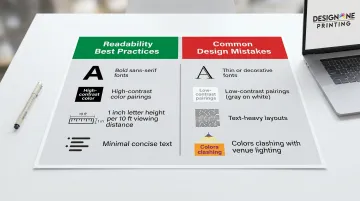
The industry-standard readability rule: 1 inch of letter height per 10 feet of viewing distance. The USSC Foundation's research shows legibility can drop to 7 feet per inch in highly congested environments like crowded trade show floors — so treat that formula as your baseline, then size up from there.
Common design mistakes to avoid:
- Thin or decorative fonts on directional signs
- Low-contrast color pairings (gray on white, dark blue on black)
- Too much text on any single sign
- Colors that clash with the venue's existing lighting or décor
Sizing and Placement Strategy
Getting the design right is only half the job — where you put each sign determines whether it actually works. Before finalizing your print order, sketch a simple venue map and mark all planned sign locations. This prevents redundancy, identifies gaps, and keeps quantities accurate.
Placement principles:
- Welcome banners: first thing guests see upon entering
- Directional signs: mounted high enough to stay visible above crowds
- Informational panels: at natural pausing points, not corners
- Backdrops: positioned near registration desks or high-foot-traffic zones
Choosing the Right Print Materials for Las Vegas Venues
Material choice affects durability, visual quality, and total cost. Las Vegas presents specific conditions — intense desert heat outdoors, bright convention hall lighting indoors, hard flooring surfaces — that should directly inform your material decisions.
Banners, Retractable Stands, and Fabric Displays
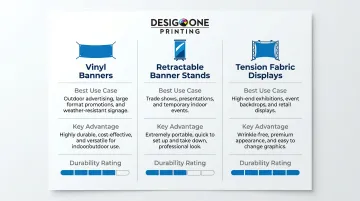
| Material | Best For | Key Advantage |
|---|---|---|
| Vinyl banners (18 oz) | Large hanging displays, outdoor use | Durable, wipe-clean, weatherproof |
| Retractable banner stands | Portable entrance/directional signage | Sets up in seconds, reusable hardware |
| Tension fabric displays | Booth backdrops, photo walls | 60–70% lighter than vinyl, glare-free, wrinkle-resistant |
Tension fabric displays are worth the investment for any signage that will be photographed. Dye-sublimated polyester creates a matte finish that performs well under both stage lighting and phone cameras. Fabric is also machine-washable and reusable across multiple events — the graphic can be replaced on the same aluminum frame, which lowers the long-term cost per use.
For outdoor Las Vegas signage, standard indoor vinyl is the wrong choice. Design One Printing's outdoor banners use 18 oz PVC with UV-stable inks and marine-grade grommets sealed with UV-protective coating.
These materials are rated for 2–4 years of continuous outdoor exposure — a meaningful difference when Nevada sun can visibly degrade lower-grade vinyl within a few months.
Foam Board, Acrylic, and Rigid Substrates
When banners and fabric aren't the right fit, rigid substrates handle tabletop signs, informational panels, and booth identification. Options include:
- 3/16" foam core — lightweight and portable; ideal for single-day schedules and pop-up promotions
- 1/2" foam core or gatorboard — resists dents in high-traffic corridors; better for multi-day events
- 3mm–6mm PVC — holds up in busy lobbies and can be reused across multiple event days
- Acrylic — premium finish for high-end displays and branded tabletop pieces
Finishing matters. Matte lamination reduces glare under overhead expo LEDs and adds scuff resistance. Gloss lamination adds visual pop for retail-style displays. Dry-erase lamination can turn a schedule board into a live-update surface.
Design One Printing, located minutes from the Las Vegas Strip, carries all of these substrates with same-day production capabilities — eliminating the delays that come with juggling multiple vendors.
Managing Signage Timelines and Rush Printing in Las Vegas
Compressed timelines are one of the most common challenges in Las Vegas event planning. Exhibitors frequently arrive days (sometimes hours) before setup, and printing delays have a way of cascading.
Planning Your Print Timeline
Use this as your baseline framework:
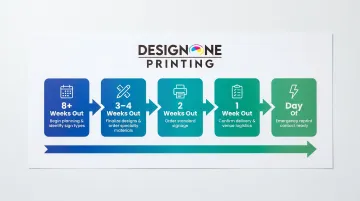
- 8+ weeks out: Begin overall exhibit planning and identify all sign types needed
- 3–4 weeks out: Finalize designs and place orders for specialty materials (fabric displays, acrylic, custom shapes)
- 2 weeks out: Place orders for standard signage (vinyl banners, foam boards, retractable stands)
- 1 week out: Confirm delivery logistics and venue receiving procedures
- Day of: Have a local printer identified for emergency reprints
Artwork files should be print-ready before submission: 150–200 DPI at full size for large format, 300 DPI for small format, CMYK color mode, 0.125" bleed minimum. Working with a printer that offers in-house design services (like Design One Printing) catches file issues before they become expensive reprints.
When You Need Same-Day or Rush Printing
Last-minute needs happen often enough that they should be built into your contingency plan. A sponsor pulls out the morning of setup. A session room changes. Freight containing your printed materials sits somewhere in transit.
Design One Printing handles same-day wide-format work (banners, booth signage, floor graphics) with a noon cutoff, and next-day production for larger or specialty formats. The process: file submission by noon, proof approval by 2 PM, production complete and ready for pickup or delivery by 5–6 PM.
Their location minutes from the Strip means same-day delivery to the LVCC, Mandalay Bay, The Venetian Expo, or Caesars Forum, with no shipping window to wait on. For time-sensitive convention deliveries, they coordinate directly with venue receiving and understand dock hours and booth access procedures.
Coordinating Installation at Las Vegas Convention Venues
Major Las Vegas venues operate under union labor rules that directly affect signage installation. At the LVCC, hanging any sign requires the official service contractor (Freeman or designated contractor) — exhibitors cannot self-install suspended signage. Weight thresholds that trigger electrician requirements:
- LVCC: 300 lbs or more
- Venetian Expo: 200 lbs or more
Freestanding signage (retractable stands, tabletop boards, meter boards) is generally self-installable within your booth space, but confirm this with each event's exhibitor services guide.
Confirm signage placement rules with the venue's event services team when booking. Build mounting dimensions and hardware requirements into your print brief from day one ; finding out on setup day that your banner needs a specific attachment type costs time you won't have.
Frequently Asked Questions
What are the main types of event venue signage?
The core categories are welcome banners, directional/wayfinding signs, branded backdrops and step-and-repeats, informational panels, table and booth signs, and safety/emergency signage. Most events need a combination of several types working together — no single sign type handles every function.
What are the latest trends in event venue signage?
Tension fabric displays have largely replaced vinyl for indoor booths due to lighter weight, better photography performance, and reusability. QR code integration has grown significantly — global QR scans increased 57% — linking attendees to digital schedules, lead capture, and session content. Bold, minimal design with strong color contrast is also replacing cluttered, text-heavy layouts.
How far in advance should I order event venue signage in Las Vegas?
Standard signage: 2 weeks minimum. Specialty materials like tension fabric displays, acrylic, or custom shapes: 3–4 weeks. Local Las Vegas printers with rush capabilities can fulfill urgent orders in 24 hours or less — but having print-ready files prepared in advance is the single biggest factor in whether same-day turnaround is actually possible.
What size should event signage be for large convention centers?
Welcome banners should be at minimum 24×36" and often larger for convention halls — panoramic spans of 20–30 feet work well for major entrances. Directional signs should be readable from 20+ feet. The baseline rule: 1 inch of letter height per 10 feet of viewing distance — size up on crowded show floors where visibility drops.
What materials work best for Las Vegas event venue signage?
Tension fabric works best for indoor backdrops and step-and-repeats; 18 oz vinyl with UV-stable inks handles outdoor or hanging displays; foam core or PVC suits tabletop signs and panels. For any open-air setup, UV-resistant materials are non-negotiable — standard indoor vinyl degrades fast under direct Nevada sun.
Can I get same-day event signage printing in Las Vegas?
Yes. Design One Printing offers same-day turnaround on wide-format work with a noon file submission cutoff, and next-day service for larger or specialty formats. Having print-ready files (correct resolution, CMYK, proper bleed) speeds the process considerably. Their location near the Strip means direct delivery to major convention venues the same day — no shipping delay required.